

Why the people asking loudest for change are often the least ready for it.
You know the scene. The staff survey comes back, and the message is loud and clear: something has to change. The listening sessions run long. People share frustrations they've been holding for years. Roles are unclear. Pay feels unfair. Nobody knows who decides what. Leadership hears it, the board hears it, and everyone agrees.
So you do the work. You assess, you plan, you redesign. Then you walk into the all-staff meeting with the new org chart, the updated handbook, and the new job descriptions.
And the same people who begged for change look at you like you just canceled the holiday party.
Welcome to the most predictable surprise in organizational life.
Change in theory vs. change in my inbox
When staff ask for change, they are almost always asking for the things that frustrate them to be fixed. They picture the broken process going away, the unclear decision getting made, the colleague who doesn't pull their weight finally being held accountable.
What they are not picturing is their own job description changing. Their own schedule shifting. Their own data entry being checked. Their own raise depending on something other than how long they've been around.
That isn't hypocrisy. It's human. Everyone supports change in the abstract. Change becomes real the moment it shows up in my calendar, my paycheck, or my reporting line.
Here's the hard truth: in most organizations, the people who asked for change are the same people who will have to do the changing. If you don't prepare them for that, your restructure will stall, and not because anyone opposed it. It will stall because everyone agreed with it right up until it applied to them.
The translation table nobody hands out
Every request for change comes with a price tag. The trouble is that nobody reads the price tag out loud until the bill arrives. So read it out loud, early.
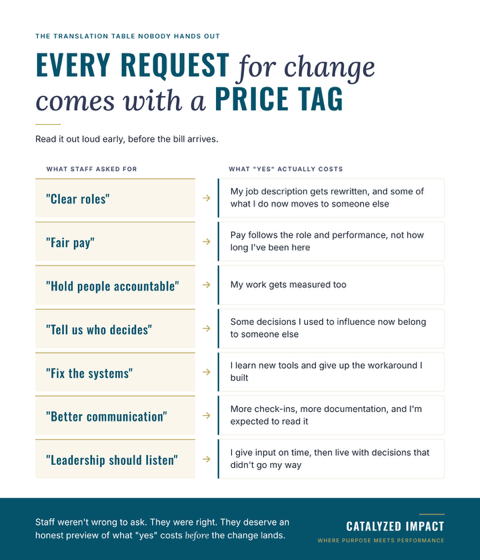
None of this means staff were wrong to ask. They were right. It means the organization owes them an honest preview of what "yes" costs before the change lands, not after.
Prepare people before you announce anything
Most change plans are really announcement plans. A slide deck, a meeting date, maybe an FAQ. That's not preparation. That's a delivery schedule. Real preparation starts weeks earlier and looks like this:
1. Name what is not changing. People can absorb a lot of change if they know where solid ground is. Mission, core programs, their team, their location: whatever is staying put, say so first and say it often.
2. Separate the decided from the open. Be explicit about which parts are final and which parts are open for input. Nothing destroys trust faster than asking for feedback on something already decided.
3. Sequence the conversations. Leadership first, then the board, then managers, then staff. Managers should never learn about a change in the same meeting as the people who report to them.
4. Offer choice where you honestly can. When roles shift, invite people to consider the role that fits their current work, or another open role, instead of simply assigning them. Choice turns "this was done to me" into "I decided this."
5. Arm your managers for the one question that matters. Every staff member will ask some version of "What does this mean for me?" If managers can't answer that clearly and consistently, the rumor mill will answer it for them.
And about that FAQ: an FAQ is not a change strategy. It's a list of questions you were afraid to answer in person.
Expect the dip. Plan for it.
Every real change has a dip. Morale drops, questions multiply, and productivity wobbles while people figure out the new normal. This is not a sign the change was wrong. It's a sign the change is real. If nobody's uncomfortable, you didn't change anything. You rearranged it.
The part that catches leaders off guard: your loudest advocates may become your loudest resisters. The person who spoke up most in the listening session often cared the most, which means they also have the most to lose when their piece of the puzzle moves. Don't write them off. Talk to them early, one on one, before the all-staff meeting. Something like:
"You were one of the clearest voices asking for this, and you were right. I want you to hear from me first what it means for your role, before the all-staff meeting. Here's what changes for you, here's what doesn't, and here's where I'd genuinely like your input."
And don't treat the big announcement as the finish line. It's the starting gun. Plan for what comes after:
· A written follow-up that answers the questions raised in the room
· A clear channel for new questions, with a promised response time
· Manager check-ins in the first 30 days
· A visible date when you'll review what's working and adjust
The follow-up questions are where trust gets built or lost. Answer them quickly, answer them consistently, and answer the uncomfortable ones too.
Leaders change first, or nobody does
Here's the part leaders like least. Staff will judge the change by one thing: whether leadership is changing too.
I learned this one the hard way. When we restructured so managers owned more decisions, I expected staff to adapt while I kept answering their questions myself whenever they showed up at my door. It felt helpful. It wasn’t. Every time I did it, I quietly told everyone the old org chart still ruled, and staff kept going around their managers because I let them. What finally worked wasn’t a memo. It was me asking “Have you talked to your manager?” and meaning it.
If the new structure asks staff to hit measurable targets, the executive needs measurable targets. If staff are expected to follow the new handbook, leaders can't keep carving out exceptions for themselves. If the plan says decisions now sit with a specific role, the person in that role has to actually make them, instead of handing the hard ones back down or out to a consultant.
The same goes for the board. A board that asks for accountability and then skips its own governance reforms is sending a very loud message.
Staff are watching. They always are. Change that only flows downhill isn't change management. It's just management, with better slides.
A readiness check before you hit "send" on the meeting invite
If you can't answer yes to most of these, you're not ready to announce. You're ready to prepare.
☐ We can state in one sentence why this change is happening
☐ We have listed what is not changing
☐ We know which parts are final and which are open for input
☐ Managers heard it first and can answer "What does this mean for me?"
☐ Every person affected has a clear path, and a choice where possible
☐ We've talked one on one with the people most affected
☐ Leadership's own goals and expectations are changing too
☐ We have a written follow-up and a 30-day check-in plan
Fewer than six yeses? Move the meeting. Seriously.
The bottom line
Wanting change and being ready for change are two very different things. Staff who ask for change are telling you the truth about what's broken. They're just not always telling you, or themselves, the truth about what fixing it will require.
That's your job. Not to sell the change harder, but to prepare people for its full weight before it arrives. Do that, and the people begging for change can become the people who make it stick.
If your survey just came back saying "something has to change," you're at the easiest part. Catalyzed Impact helps organizations do the harder part: getting people ready to change before the org chart does.
Annemarie Grassi Amefia, Ph.D., is the Founder and Principal Strategist of Catalyzed Impact.