Rebuilding Fostering Hope
From Operating Deficit to Sustainable Strength
A nineteen-month transitional leadership and organizational transformation engagement spanning finance, governance, human resources, fund development, program design, and evaluation.

Fostering Hope Ohio, a nonprofit serving youth in foster care and residential treatment, entered late 2024 facing a structural operating deficit, fragmented financial systems, an unaccountable program model, and a leadership vacuum. Catalyzed Impact was engaged to serve as Transitional Executive Director and lead a full organizational turnaround: stabilizing finances, rebuilding infrastructure, redesigning programs around evidence-based practice, and recruiting a permanent CEO.
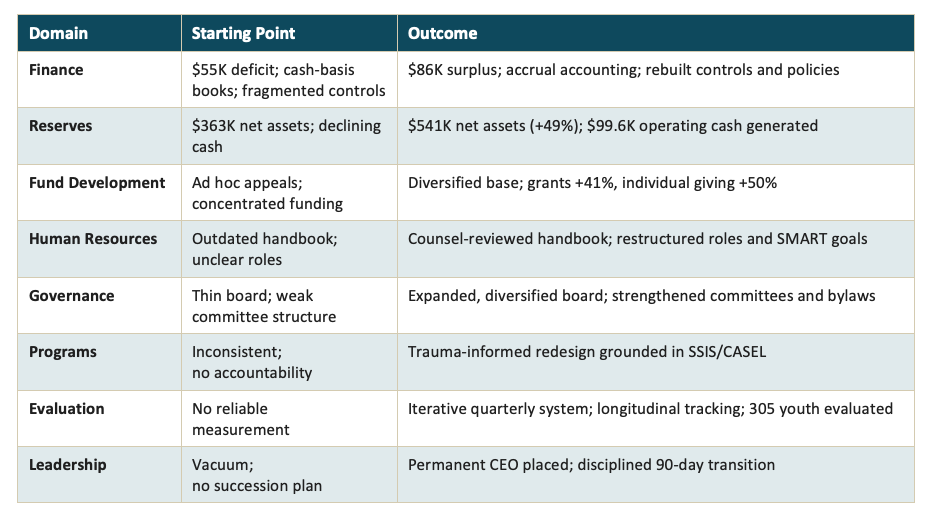
Over nineteen months, the organization moved from a $55,137 net deficit to an $85,934 surplus (a $141,071 swing) while growing net assets nearly 50% and rebuilding the program evaluation function from the ground up. The engagement concluded with the successful placement of a permanent CEO and a disciplined 90-day transition.
+$141K
Net Revenue Swing
305
Operating Cash Swing
+49%
Net Asset Growth
+$205K
Youth Evaluated (4 Cycles)
The Challenge
A multi-year erosion of financial controls, program accountability, and data systems had left the organization operating at a deficit with weakened infrastructure and no permanent executive leadership. Fundraising had been historically misrepresented, contractor costs had run over, and no reliable system existed to measure program impact.
The Approach
Catalyzed Impact embedded as transitional leadership and executed a simultaneous, multi-workstream turnaround: rebuilding financial systems and moving to accrual accounting; restructuring human resources and staffing; diversifying and growing the funding base; redesigning programs around trauma-informed theory; and building a rigorous, longitudinal evaluation function. Each work stream was designed to outlast the engagement.
The Result
A financially healthy, well-governed organization with growing reserves, a diversified funding base, evidence based programming, a functioning evaluation system, and permanent leadership in place, positioned for its next phase of growth rather than merely rescued from crisis.
The Starting Point
Fostering Hope Ohio provides trauma-informed programming and material support to youth in foster care, kinship care, and residential treatment across Northeast Ohio. Its work spans two program areas: Health &Wellness (creative arts, yoga, and gardening delivered in residential settings) and Childhood Experiences (Journey Bags, Birthday Boxes, Birthday Wishes, and Holiday Giving).
When Catalyzed Impact was engaged in late 2024, the organization faced converging pressures that threatened its stability:
Structural deficit. The organization was on track for a year-end deficit of roughly $60,000, compounded by historical misrepresentation of fundraising results that had distorted the operating budget.
Fragmented financial systems. Duplicative payment processes, an unclear chart of accounts, cash-basis books, and blurred roles between executive, accountant, and bookkeeper obscured the true financial picture.
Weak program accountability. Years of limited quality control had produced inconsistent practices, unclear expectations, and, critically, no reliable system for tracking program effectiveness.
Leadership vacuum. The organization needed both day-to-day executive leadership and a structured search for a permanent CEO, without losing momentum or stakeholder confidence during the transition.
The Mandate
Stabilize the organization, rebuild its financial and operational infrastructure, redesign programs around evidence and impact, and recruit permanent leadership, leaving behind systems strong enough to sustain growth.
Evidence of Impact
The resulting evaluation produced credible, funder-ready evidence across four program cycles.
Regression fell to and held near its lowest recorded level (13% to 14%) for two consecutive cycles, even as positive outcomes fluctuated with cohort composition. Youth reliably named concrete coping tools in their own words at program completion, and returning-youth tracking showed most participants sustaining or improving functioning across seasons. The organization's widest point of contact, Childhood Experiences, delivered 1,897 items of support across FY26, reaching a population that is predominantly youth of color (61% Black/African American) and nearly all low-income (99%).
WHAT DISTINGUISHES THIS WORK
Evaluation designed for honesty about its own limits: consistent measurement across cycles, individual trajectories recovered through identifier linkage, and each program matched to an instrument suited to its dosage. Evidence that is credible precisely because its boundaries are named.
220
New Volunteers
72%
Combined Positive Rate
20%
Combined Regression Rate
180
Unduplicated Youth (FY26)
Outcomes At a Glance

Why It Matters for
Your Organization
This engagement demonstrates what Catalyzed Impact brings to organizations in transition: the ability to stabilize finances and rebuild infrastructure while simultaneously elevating program quality and building the evidence base that funders and boards require. The work was designed to outlast the engagement, leaving behind systems, policies, evaluation capacity, and leadership strong enough to carry the organization into its next phase of growth.

work with us
READY to MAKE an IMPACT?