Building the Organization Around the Mission
Standing Up the Nonprofit Infrastructure Behind a Founder-Led Movement
True Beauty Discovery (TBD) was founded in 2019 by actress and writer Holly Fulger, growing out of her earlier media work challenging narrow and harmful beauty standards. The mission was clear and the content was strong. What did not yet exist was an organization.
For most of its life, TBD functioned as a program rather than a nonprofit. Workshops were delivered as standalone events. The board was a founding board rather than a governing one. Funding rested on a small number of relationships. There was no reserve, no staff, and no evaluation infrastructure to demonstrate whether the work was doing what it claimed to do.
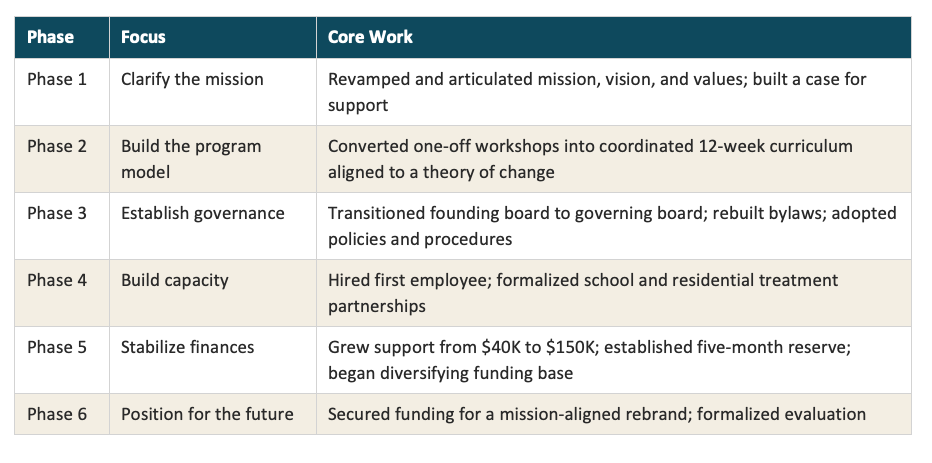
Catalyzed Impact was engaged to change that. The first year of the engagement was not a fundraising campaign or a strategic plan exercise. It was organizational construction: rebuilding the governance layer, converting a workshop model into a sequenced curriculum, formalizing partnerships, hiring the first employee, and moving the organization from financial fragility to a five-month reserve.
This case study documents the first year of an engagement that is active and ongoing. It is not a report on a finished project. TBD is at the beginning of its organizational build, and the next phase of work, building and diversifying sustainable funding streams, is just now getting underway. What follows describes a foundation laid, not a transformation completed.
It is offered as a working model for founder-led nonprofits that have a compelling mission and a loyal following, but lack the structure to scale, sustain, or prove impact.
The Situation
TBD arrived at the engagement with genuine assets. It had a founder with authentic authority on the subject, a distinctive identity framework in the 7 Legends, a defined age band of girls ages 11 to 19, and a body of media work that had already established credibility with an audience.
It also arrived with the conditions that stall founder-led nonprofits at exactly this stage.
Program Without Architecture
Programming existed as discrete workshops. Each one could be good in isolation, but there was no sequence, no dosage logic, and no articulated pathway from a girl attending a session to a girl demonstrating changed identity, voice, or confidence. Without that architecture, the organization could describe what it did but not what it produced.
Governance In Name Only
The board was a founding board. Its members had been recruited for early support and proximity to the founder, not for governance capability. Bylaws were outdated. Core policies were absent. The organization had the legal form of a nonprofit without the operating discipline of one, which limited its credibility with institutional funders and exposed it to risk.
Financial Concentration
Roughly $40,000 in annual support, sourced narrowly and dependent on the founder personally, meant every year began from zero and every commitment carried risk. There was no reserve to absorb a delayed grant or a lost donor.
No Evidence Base
The mission is about internal change: identity, confidence, voice. That is measurable, but it had not been measured. Without evaluation data, TBD was asking funders to invest in conviction rather than evidence.
The Approach
The engagement was structured around a simple sequencing principle: identity before infrastructure, infrastructure before growth. An organization cannot build durable governance, staffing, or funding around a mission it has not clearly articulated. So the work began with language, then moved to structure, then to capacity.
Where the Organization Stands at Year One
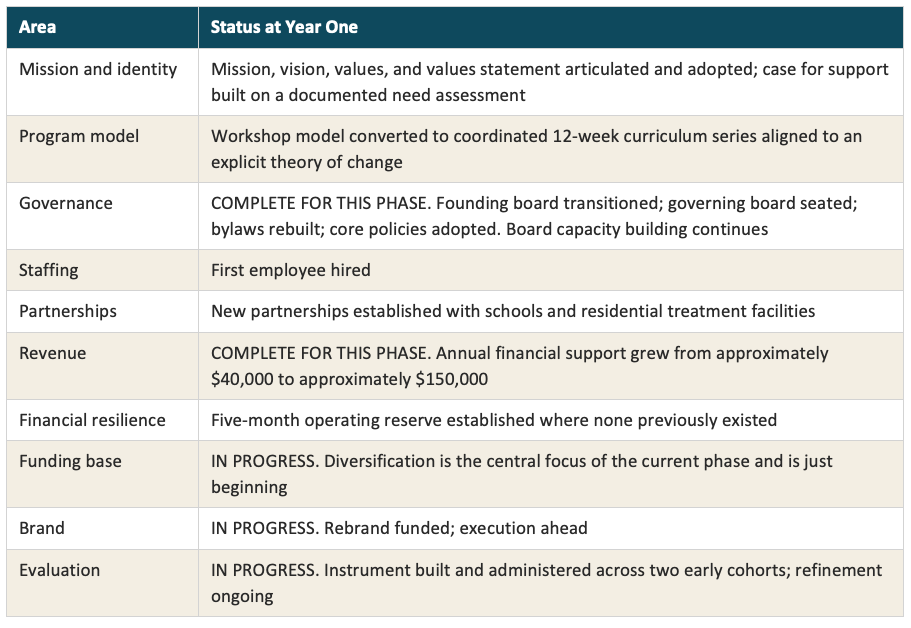
The following reflects progress at the close of year one of an ongoing engagement.
Several items are complete; several are deliberately still in motion. Both are noted.
What This Engagement Demonstrates
Mission language is infrastructure, not marketing
The temptation in a founder-led organization is to treat mission work as a branding exercise to be done later. In practice it is the load-bearing element. TBD could not build a theory of change, an evaluation instrument, a curriculum sequence, or a credible case for support until the mission was specific enough to test. Every subsequent deliverable in this engagement traces back to that first piece of work.
Founding boards must be transitioned, not tolerated
A founding board and a governing board are different instruments. Founding boards are recruited for belief; governing boards are recruited for fiduciary and strategic capability. Organizations that delay this transition out of loyalty pay for it in funder credibility and unmanaged risk. The transition can be done respectfully, and it is the precondition for institutional funding.
Sequence creates measurability
The move from one-off workshops to a 12-week series was a program decision with evaluation consequences. Sequenced delivery produced the pre and post window, the dosage, and the relationship depth that made outcome measurement possible. Organizations that cannot demonstrate impact often have a delivery-model problem rather than a measurement problem.
A reserve is a strategy document
The five-month reserve changed what TBD could decide, not just what it could absorb. Hiring the first employee, committing to multi-session school partnerships, and undertaking a rebrand all became defensible decisions once the organization had a cushion. Reserves are usually discussed as risk management; they function as strategic capacity.
Founder-led does not mean founder-dependent
Holly Fulger’s authority on this subject is an asset and remains central to TBD’s voice. The purpose of this engagement was never to reduce the founder’s role but to ensure that the mission does not rest solely on it. Staff, board, curriculum, partnerships, reserve, and evaluation together distribute what was previously carried by one person.
Current Phase of Work
TBD is early in its organizational build. The engagement continues, and the priorities below are active work rather than future aspirations. Fund development and revenue diversification lead the list because that is where the organization now stands.
Build and diversify funding streams. The central focus of the current phase. Move from a concentrated base toward multi-year institutional, foundation, corporate, and individual support
Complete the rebrand. Execute the funded rebrand and align all program, development, and digital assets to the new identity
Refine evaluation. Address ceiling effects observed in goal-setting and connection items; build toward a defensible longitudinal evidence base
Scale partnerships. Expand school and treatment facility relationships using the 12-week model as the standard delivery unit
Build board capacity. Develop the seated board’s fund development and program oversight function
Grow staffing. Move from first employee toward a small, sustainable staffing structure

work with us
READY to MAKE an IMPACT?